


Macquarie looks for diversity with Commodity Bonds
8.2%pa, a global fund manager managing capital risk and a Standard & Poor’s
credit ratingi makes an attractive combination. But in the current
environment of nervousness around the riskier end of the market in New Zealand,
and with the lack of rated alternatives, Commodity Bondsii have quickly
gained a lot of appeal with institutional and retail investors.
What are Commodity Bonds? Commodity Bonds offer a 5 year fixed income stream
of at least 8.2%pa, paid quarterly. They are expected to be issued with a credit
rating within Investment Grade that historically has related to a 99.5% probability
of full capital and income payments being metiii.
But this strong yield and credit rating are not the main attraction for these
investors. Its diversification - that is the big story for New Zealand investors,
particularly those concerned about recent finance company defaults and stories
of investors that were insufficiently diversified to avoid having major lifestyle
impacts from these defaults.
Is diversification really that difficult? With all the choices available: capital
notes; property trusts; investment property; finance debentures; Kiwi Bonds,
its easy to diversify, isn’t it?
However, what if there was a shock to the New Zealand economy? While highly
unlikely, imagine the effect of a shock to the economy that would be caused
by, say for example, a foot and mouth breakout in New Zealand.
Such an outbreak would have consequences for every part of the economy, and
therefore would impact all New Zealand fixed interest investments listed above.
A portfolio spread across multiple New Zealand based investments may not be
as diversified as it may appear at first glance.
The key questions to ask when designing a fixed income portfolio for your clients
are: “What is it that provides the cashflow used to pay my interest costs
on each of my investments?”; and “Are there any single event risks
that could impact all of these cashflows at once?”.
Commodity Bonds derive their cashflow by taking commodity price risk on the
principal, in much the same way that a dairy company’s capital notes pay
interest in return for investors taking dairy price risk, or a retail company’s
capital notes pay interest in return for investors taking risk on the level
of retail spending. But these commodities are not linked to the New Zealand
economy eg the price of Gold would not fall if there were a recession in New
Zealand.
Some key points to note about Commodity Bonds and their link to commodity prices:
1. Commodity Bonds do not require prices to rise to be able to pay 8.2% pa
2. If prices fall to long-term averagesiv over the next five years,
there is no impact on the return to Commodity Bond investors. That is why they
are able to be rated Investment Grade by Standard & Poor’s –
corporate issuers with the same credit rating experienced a 5 year default rate
of around 0.5%, or 1 in 200iii.
3. Having a manager is intended to assist in protecting against a loss of principal
on the Commodity Bonds. The manager will have the ability to make changes to
the underlying reference portfolio of commodities in order to attempt to preserve
the principal at the end of the 5-year term.
Price falls below long-term averagesiv over a 10 day period near
the end of the 5 year term may affect the return of principal as set out in
section 3 of the Offer Document.
| Profit from commodities even if prices don’t rise Commodities and falls required before any potential impact on the principal of Commodity Bonds*. This illustration is based on the portfolio as at 10 July 2006. The only commodity from the energy sector currently included in the portfolio is Natural Gas. |
Want to read the full article?
Click the button below to subscribe and will have free unlimited access for a limited time to full article and all other articles on the site. You will also be able to comment on articles on Good Returns.
Latest News
|
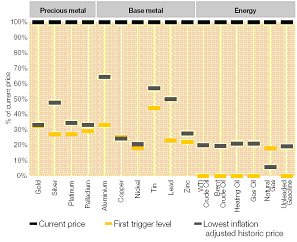 * As at 10 July 2006 the Protection Amount protects the principal of the
Commodity Bonds from the first 7 Portfolio Events. One subsequent event
will reduce this principal to zero. A Portfolio Event occurs when the
price of a commodity over a 10 day averaging period near the end of the
5 year term is below the relevant trigger level.
* As at 10 July 2006 the Protection Amount protects the principal of the
Commodity Bonds from the first 7 Portfolio Events. One subsequent event
will reduce this principal to zero. A Portfolio Event occurs when the
price of a commodity over a 10 day averaging period near the end of the
5 year term is below the relevant trigger level. ![[Weekly Wrap] KiwiSaver in play; but outcome unclear](https://goodreturns.publit.io/file/c_fill,w_300,h_200/0ad582e4-c9a3-4692-bbe2-62d928f77fd2.jpg)