


Blogs
The lighter side of the credit crunch
Friday 28th of March 2008
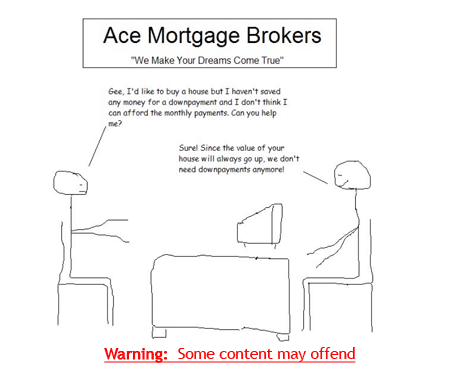
The credit crunch is pretty horrible and sad (especially if you or your clients are exposed to it), but you can have a laugh too. Over recent weeks we have been sent a number of humorous takes on how the credit markets work, from a ditty to the lyrics of a Queen song, through to a very funny slide show.
HOW THE CDO MARKET WORKS

Once upon a time in a village, a man appeared and announced to the villagers that he would buy monkeys for $10 each.
The villagers seeing that there were many monkeys around, went out to the forest, and started catching them.
The man bought thousands at $10 and as supply started to diminish, the villagers stopped their effort.
He further announced that he would now buy at $20. This renewed the efforts of the villagers and they started Catching monkeys again.
Soon the supply diminished even further and people started going back to their farms.
The offer increased to $25 each and the supply of monkeys became so little that it was an effort to even see a monkey, let alone catch it!
The man now announced that he would buy monkeys at $50! However, since he had to go to the city on some business, his assistant would now buy on behalf of him.
In the absence of the man, the assistant told the villagers. "Look at all these monkeys in the big cage that the man has collected. I will sell them to you at $35 and when the man returns from the city, you can sell them to him for $50 each."
The villagers rounded up with all their savings and bought all the monkeys.
Then they never saw the man nor his assistant, only monkeys everywhere!
Now you have a better understanding of how the Collateralised Debt Obligations market works. |
Want to read the full article?
Click the button below to subscribe and will have free unlimited access for a limited time to full article and all other articles on the site.
You will also be able to comment on articles on Good Returns.
Latest News

2 min read
3 min read

2 min read
Latest Comments
FMA outlines its latest expectations for advisers
Paul Flood: The danger is that the 'goalposts' (regarding what is acceptable or unacceptable adviser conduct) may be susceptible to change. Our 'Principles based' legal/regulatory environment lends itself to “prevalence-induced concept change” over time, perhaps not so much in the written laws and Code, as in the interpretation of the prescribed principles.
1 day ago Steve Wright
FMA outlines its latest expectations for advisers
Just a tip, if you use more than six, six letter words in a sentence you lose most Kiwi's. So avoid client/adviser confusion when writing your post or article if you would like it read and understood.
Ironically, my last sentence was not likely read.
1 day ago Backstage
FMA outlines its latest expectations for advisers
All things said are great aspirational goals for a great financial advice industry, it mirrors what both the legislation and the code requires.
However, like most things discussed it talks about what's expected not how it's done. The hardest aspect of financial advice today isn't what it is, it is how it is done.
The how only comes from those that have done it, the how is only provided with examples. Guidance documents that spell out what's required along side how it it done.
We’re still dealing with the same issues we started with in 2021, figuring out the how. And figuring out the how in every advice business is consuming resources that could easily be shortcut by the FMA demonstrating what they are expecting.
It's not about “do it this way” its about this is the sorts of things we’re looking for.
In the absence of standards and expectations, guesswork prevails. That represents significant risk to FAPs and the result is onerous overcooked advice processes for multiple advice operations and undercooked she’ll be right for single operators focused on getting the work done.
Both approaches have potential for harm and as its been said earlier, leaves advisers open to explain they haven't been speeding with the authorities have pulled them over.
The advice industry needs guidance on the how we know the what already.
3 days ago Jon-Paul Hale
Who is responsible for notifying policy changes?
Sticking an oar in, while we have “service” requirements the expectation that an adviser is responsible for discussing said change is relying heavily on assumption.
1. That the client hasn't moved and contact details haven't been updated. It happens more often than many think.
2. It assumes there is a servicing agreement in place to provide service. Remember the requirement is to scope service not provide it. A client deciding to have ad-hoc service on their request is a legally valid position to have.
3. If there is a service agreement that's realistic to what is expected, how long does the adviser push the issue to have the discussion before moving on with everything else they have to do? Again, a point that is not clear in the guidance to date.
The challenge of the present rules is the adviser is responsible for ensuring the client understands the advice provided.
How do you ensure you're covering this if a client doesn't engage despite genuine attempts to manage it?
There's still a lot of “what if’s” in this whole are we’re only going to have clarity on once someone is taken to task about it.
But first we need to have clarity on what ongoing service actually is, because right now demonstrated by the direct providers a letter once per year with a please call if you want to discuss is the current minimum…
3 days ago Jon-Paul Hale
FMA outlines its latest expectations for advisers
To correct errors in my previous post: "policies, templates, and controls" should read "policies, processes, systems and controls", and "is more conductive" should read "is more conducive".
4 days ago Paul Flood
Once upon a time in a village, a man appeared and announced to the villagers that he would buy monkeys for $10 each.
The villagers seeing that there were many monkeys around, went out to the forest, and started catching them.
The man bought thousands at $10 and as supply started to diminish, the villagers stopped their effort.
He further announced that he would now buy at $20. This renewed the efforts of the villagers and they started Catching monkeys again.
Soon the supply diminished even further and people started going back to their farms.
The offer increased to $25 each and the supply of monkeys became so little that it was an effort to even see a monkey, let alone catch it!
The man now announced that he would buy monkeys at $50! However, since he had to go to the city on some business, his assistant would now buy on behalf of him.
In the absence of the man, the assistant told the villagers. "Look at all these monkeys in the big cage that the man has collected. I will sell them to you at $35 and when the man returns from the city, you can sell them to him for $50 each."
The villagers rounded up with all their savings and bought all the monkeys.
Then they never saw the man nor his assistant, only monkeys everywhere!
Now you have a better understanding of how the Collateralised Debt Obligations market works.