


Investments
Harbour:The methadone approach to market recovery
Wednesday 4th of April 2012
Key points:
- While developments in Europe drove NZ fixed interest markets in 2011, the future of the Quantitative Easing (QE) in the US will be a key driver in 2012.
- As the size of QE has grown since the start of the GFC, markets and the economy have become more dependent, increasing the challenge of QE exit.
- The decision as to when to wean the market off QE will depend on the prospects for US unemployment and inflation, which are noticeably better than when the Fed embarked on QE1 and QE2.
- However, the Fed will be cautious about withdrawing the drug from the patient, and attempt to guard against a sharp rise in long-term interest rates before the economy can stand on its own feet.
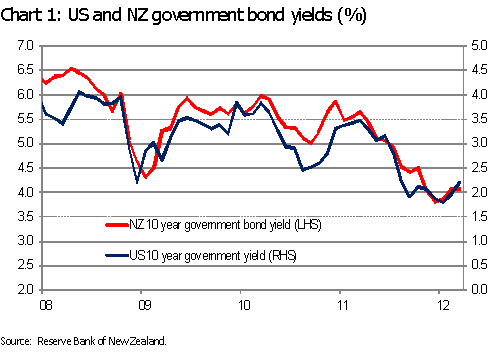
While developments in Europe drove NZ fixed interest markets in 2011, the future of the Quantitative Easing (QE) in the US will be a key driver in 2012, particularly given the tight relationship between US and NZ government bond yields (Chart 1). Over the course of March there has been heightened speculation about how long the stimulus from QE will remain and when the US Federal Reserve will eventually exit QE.
Want to read the full article?
Click the button below to subscribe and will have free unlimited access for a limited time to full article and all other articles on the site.
You will also be able to comment on articles on Good Returns.
Latest News

Latest Comments
Simplicity fund reclassification ‘may have boosted returns’
The Morningstar classification rules have always been problematic. Their split kicks you from Balanced - Growth at just 60% in Equities verus MJW's 69% and Sorted/FMA's 63%. Likewise if you exceed 80% in Equities you get re-classified from Growth - Aggressive versus MJW's 85% and Sorted/FMA's 90% splits respectively. In some parts of the world Aggresive is classed as 95% - 100% Equities.
6 hours ago Peter Urbani
Advisers embrace Westpac after trail commissions removed
@ The Laird - I wasn't suggesting the increase in upfront from Westpac caused the small uplift in adviser-generated loans.
You rightly point out this hypothesis is not supported by the evidence. Nor is the hypothesis that an uplift in adviser-generated loans following the removal of trail commissions suggests that advisers are not predominantly driven by commission considerations.
The UK report is flawed, for the same reason the 2016 FMA work on churn is flawed. Neither regulator is looking in the right place/at the right data, if they're looking to find evidence of "churn".
To be clear: I am not suggesting there is a "churn" problem. Only that the lapse-rate spike following the end of the clawback period is not the place to look.
7 hours ago Paul Flood
Advisers embrace Westpac after trail commissions removed
@Paul - maybe so, but that's a hypothetical claim for which there is no evidence.
The reality is that here, and from the recent UK report on risk commissions, there appears to be no empirical evidence that remuneration is the dominant influence in product recommendations from intermediaries.
Whether we ever move to a fee charging environment in the mortgage advice space seems unlikely.
The UK report suggested that the research identified no significant client harm based on adviser commissions.
1 day ago The Laird
FMA wants clearer fees
The Report (p.14) contains the following recommendation for FAPs: "Disclose commissions as a dollar figure. While commissions can be disclosed as either a percentage or dollar figure, we consider disclosure in dollar terms to be good practice to assist with investors readily understanding what the adviser will get out of the advice process."
Disclosing commission in dollar figures was one of the 3 options floated in the April 2018 Disclosure Requirements discussion paper from MBIE.
This option was ultimately rejected in favour of a principles-based approach.
The examples of commission disclosure in the resulting Regulations ("Connor and Ari") are expressed in percentage terms.
While the FMA may hold the view that disclosure in dollar terms is "good practice", this is not where the regulations landed at the conclusion of the 2018 consultation process.
3 days ago Paul Flood
Advisers embrace Westpac after trail commissions removed
@The Laird - No, not really. The headline of this article could equally have been: "Advisers embrace Westpac after upfront commissions increased to highest across the main banks."
4 days ago Paul Flood