


The Cloud Comes Home: New Zealand's Data Centre Moment
By David Fyfe, Mint Asset Management, Portfolio Manager.
Barely two years after the electricity market was making headlines for the wrong reasons (coal trucks to Huntly, low lake levels making front-page news), a new kind of power story is dominating the conversation: this time about demand, not scarcity. Data centres have gone from a niche infrastructure topic to a genuine stockmarket catalyst, and New Zealand looks well placed to win a real share of the global boom.
The more useful question isn't really whether New Zealand can attract this investment. On the numbers below, it clearly can. The question worth asking is whether that investment ends up genuinely working for New Zealand: growing the economy, keeping a meaningful share of the country's own data and AI capability under New Zealand sovereignty rather than routed offshore, and doing all of this without straining the same electricity system everyone else depends on. Get those three things right and this is one of the more attractive growth stories on the NZX in years. Get them wrong, and the same demand re-rating today's winners becomes tomorrow's problem.
The opportunity, sized properly
New Zealand's data centre footprint is currently punching below its economic weight. Boston Consulting Group estimates the country holds around 125MW of capacity today, roughly half the share of the global market you'd expect from an economy New Zealand's size.¹ BCG models that gap closing fast, with capacity growing six to eleven-fold by 2035 depending on how aggressively New Zealand competes for the work.¹ The economic case scales with it: a conservative build-out could unlock up to $70 billion in economic activity by 2035, and a more ambitious one closer to $160 billion.¹
New Zealand's pitch rests on more than cheap power. BCG rates potential data centre destinations across energy, connectivity, political and business stability, physical environment and construction cost, and New Zealand scores well across most of them: a strong rating on the World Energy Council's global energy security index, one of the more stable democracies anywhere, and one of a small number of countries the EU trusts with sensitive data, a status Australia doesn't share.¹
Not just someone else's compute: the sovereignty case
The growth numbers are the easy part of the pitch. The harder, and arguably more important, question is what New Zealand actually gets out of hosting this infrastructure beyond rent and construction jobs.
The honest answer is that it depends on what gets built. A data centre that simply serves offshore hyperscale customers is, economically, closer to a large export-earning warehouse: valuable, but not obviously different in kind from any other foreign-facing infrastructure investment. What changes the picture is domestic digital sovereignty: New Zealand government agencies, hospitals, banks and businesses increasingly need AI tools and sensitive data processing to happen on infrastructure that sits under New Zealand law, rather than routed through servers in another country's jurisdiction. CDC, the Australian and New Zealand data centre operator majority-owned by Infratil, is explicit about this positioning itself, describing its business as sovereign digital infrastructure built for national critical functions. Australia's own National AI Plan makes the same case for locally hosted AI models as a matter of national resilience, not just economics.⁷
New Zealand's own case for this is genuinely strong on paper. The country's flagging productivity growth, a challenge the IMF examined in detail in 2025,²⁹ is one of the more persistent problems in the economy, and BCG argues that more local compute capacity is one of the practical levers for lifting AI adoption across ordinary New Zealand businesses, rather than leaving them dependent on offshore infrastructure with its own queues, costs and latency.¹ That only shows up in the numbers, though, if local capacity actually gets built and used for local purposes, not just leased out to the largest global customer willing to pay for it.
The Infratil story: from side-bet to centrepiece
If one listed name has been transformed by this thematic, it's Infratil. Its stake in CDC, now just under half the company, has gone from a modest position to one worth roughly A$9.2 billion in the space of a few years, and CDC has become the single biggest driver of Infratil's own share price.⁶
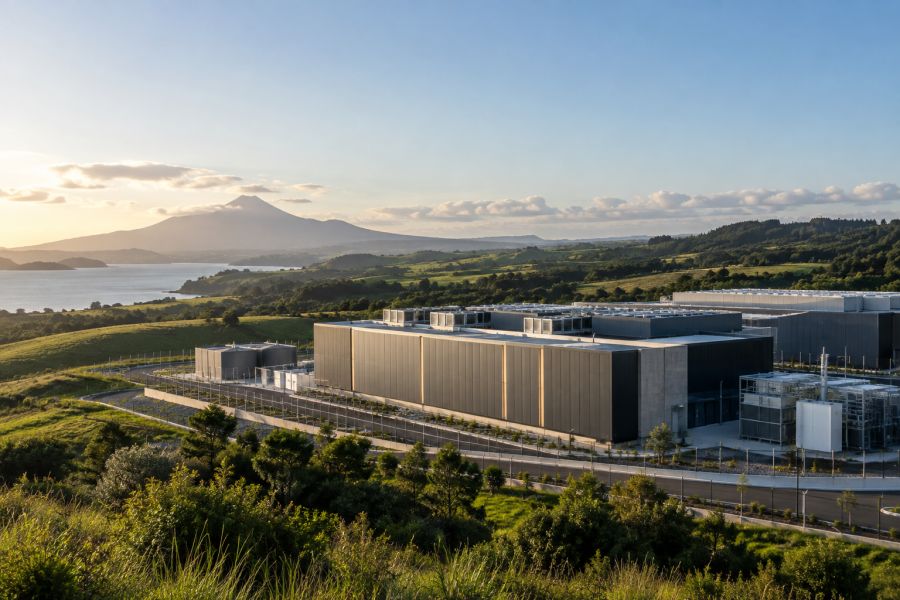
CDC's Auckland campuses, at Silverdale and Hobsonville, already run close to 100MW of live capacity, with more than double that committed as current expansion completes.⁴ Both sites have been carbon-neutral certified since their first year of operation.⁴
In August, CDC announced it's exploring a new site with Contact Energy at Stratford, Taranaki, on land next to Contact's old Taranaki Combined Cycle plant, timed against that plant's own expected 2026 retirement.⁵ ¹⁶ It's a tidy bit of symmetry: a thermal plant earmarked for closure potentially giving way to renewable-backed digital infrastructure on the same site.
Infratil isn't the only large, quasi-public money in this trade, either. Close to half of CDC's own ownership sits with Australian Commonwealth-linked funds, the Future Fund and Commonwealth Superannuation Corporation.⁷ Sovereign capital treating this as a national-interest-grade asset class in Australia is a useful data point for how the same question should be weighed here.
What it means for the gentailers
For the gentailers, the opportunity looks simple on paper: sign long-term power contracts with data centre developers, and build genuinely new generation to match. The more interesting question is whether that stays additive to the country, powering up real new capacity for a fair return, rather than quietly becoming a case of leasing out New Zealand's cheapest, most reliable renewable generation to whichever offshore hyperscaler pays the most, on terms that lock up decades of the country's own energy advantage without much coming back the other way.
Mercury has gone furthest with a confirmed commercial deal: a long-term power agreement with Datagrid's proposed Southland facility, followed in July by a stake of roughly NZ$53 million in the company itself, which at least keeps some of the upside onshore rather than purely offshore.⁸ The Datagrid project, planned near Invercargill, is targeting 280MW in its first phase and would become the country's second-largest single electricity user after Tiwai Point.⁸ ¹⁴ Contact's involvement runs through its own CDC Stratford exploration, so gentailer interest in this thematic is broader than a single deal. Mercury's own chief executive has described the wider standoff over further contracts as a "chicken and egg" problem: generators want a firm contract before investing in new supply, while developers want confirmed supply before committing.¹⁴
Firming the grid: the margin was already thin
This is where the growth story runs into the stability half of the equation, and it's the part that matters most for the country as a whole, not just for shareholders. As the OECD put it in its 2026 economic survey, New Zealand's real electricity challenge as demand rises isn't building more renewable megawatts, it's making sure there's enough firm supply to cover the dry years when wind, solar and hydro all fall short at once.¹³
In principle, New Zealand is well set up for this. Hydro can be ramped up and down to smooth out variable wind and solar, and geothermal runs at a steady output around the clock, which BCG describes as "perfectly matched to data centre users."¹ That's a genuinely good natural fit for a type of demand that never switches off.
In practice, the margin was already tighter than ideal before data centres arrived. A 2025 review for the electricity industry noted that a fully affordable, long-term replacement for gas and coal as the back-up fuel for low-rainfall years hasn't yet been settled on, and Transpower's own modelling at the time flagged supply margins narrowing toward the end of this decade even before this new demand was added.²⁰ Part of the challenge is more economic than technical: the plant needed to cover an occasional bad year might only run once every five to seven years, which makes it a harder investment to finance than steadier, higher-utilisation assets.²⁰
The government's current answer is a liquefied natural gas import facility, planned for Taranaki and targeted for 2027-2028, intended to give the system a flexible backup fuel as domestic gas supply keeps declining.³⁰ Questions around cost and outcomes hang heavily over this solution. Data centre policy has become part of the election conversation too, including the Green Party's proposed moratorium on new consents, but the more useful question for the country isn't which party wins; it's whether enough new, firm generation, gas-backed or otherwise, actually gets built in time to keep this additive rather than extractive.²³
The guardrails that decide which story New Zealand ends up with
There are really two safeguards that decide whether this stays additive to the country or starts eating into what everyone else relies on, one on the supply side and one on the demand side, and what's actually been put into law differs sharply from what's merely been suggested.
The first is a simple principle: new data centre demand should come with genuinely new generation attached, rather than quietly drawing down the hydro storage the rest of the country relies on in a bad year. BCG's own recommendation for New Zealand is to require developers to back their power contracts with new, incremental generation rather than existing supply.¹ Australia's energy regulator is proposing something similar: making hyperscale developers pay for their own generation and firming rather than lean on the grid's existing headroom.²⁶ Neither country has actually legislated this yet; both remain industry recommendations.
The second is demand flexibility, and here the picture depends heavily on what the data centre is actually doing. Training a large AI model is a long batch job with no one waiting on the other end, so it can usually be paused, slowed or timed around grid stress without anyone noticing. Answering live user queries is a different matter, latency-sensitive and much harder to interrupt, though even there, overseas research suggests more flexibility is available than people assume.²⁷ A few places have already turned this into rules rather than research: Texas requires large loads to accept emergency curtailment, Virginia requires utilities to build flexibility programmes for its biggest customers, and Britain's grid operator is looking at making flexible connections a condition of getting one at all.²⁸
New Zealand hasn't formalised either safeguard yet. Both remain ideas on the table rather than rules on the books.
The ESG angle: closed-loop cooling, done properly
The most legitimate criticism of data centres offshore is water use. Conventional evaporative cooling draws continuously on local supply, the mechanism behind this year's headlines from drought-stressed Georgia, where data centres were caught taking tens of millions of gallons of water without authorisation.¹⁰
CDC does it differently: a closed-loop system, filled once and recirculated for the life of the building rather than drawn continuously from rivers or aquifers, saving billions of litres a year across its Australian and New Zealand sites.⁷ New Zealand's cooler climate helps too, cutting cooling demand well below what warmer markets need.¹
That's not to say there's zero local friction. The more common real-world issue in New Zealand is stormwater runoff during construction, not water depletion, and where water offtakes are genuinely needed, iwi consultation is both essential and, in places, a legal requirement.¹ Datagrid's Southland consent, for instance, allows up to 600,000 litres of groundwater a day, about what a small town uses, even though the company expects to rely mainly on rainwater in practice.⁸
The social licence test: straight from CDC's own founder
In September this year, CDC founder Greg Boorer wrote an opinion piece in the Australian Financial Review responding to Australia's national cabinet backing mandatory national standards for data centre energy, water and land use.² Coming from the operator of New Zealand's largest campuses rather than an outside critic, his argument carries weight, and it applies the same additive-generation logic to the industry's own behaviour rather than to government policy.
Boorer's framing: legislated minimums are welcome, not an attack on the industry; they're a sign the industry has become important enough to warrant them. But a legislated floor can't be the industry's ceiling; the businesses that want durable permission to keep building need to compete on the strength of their standards, not just the speed of their consenting.² He traces this back to CDC's own founding in 2007, during Australia's Millennium Drought, when the industry-standard approach was evaporative cooling towers, the wrong model, in his telling, for a country where water restrictions were daily news. CDC's decision to engineer water out of primary cooling altogether wasn't required by regulation or requested by any customer at the time; it simply cost more, for years, before anyone particularly noticed.²
He sets out a four-part test he thinks the whole industry, not just CDC, should be judged against to earn genuine social licence: engage communities honestly before formal planning notification rather than after; fund the full cost of grid connection and bring genuinely new generation to the table, rather than push higher network costs onto ordinary households; site facilities on industrial and employment land rather than displacing housing or productive farmland; and design in local benefit-sharing from the outset rather than bolting it on after opposition has already formed.² He's also blunt about "phantom" data centres: projects announced without the capital or genuine intent to build, which clog up planning and grid queues and make legitimate operators look speculative by association.²
Australia is now moving toward binding, legislated minimum standards via national cabinet.² New Zealand's equivalent efforts so far, DataCentres New Zealand's own industry strategy and BCG's recommendations, remain industry-led and voluntary.³ ¹ Because CDC operates both Australian and New Zealand campuses under one corporate umbrella, any standard the company adopts in response to Australian regulation could plausibly flow through to its New Zealand operations as house policy well before local rules require it.
Why the offshore horror stories travel less well here, with one important caveat
Ireland's data centres already account for close to a quarter of the country's metered electricity consumption, enough that grid operator EirGrid has resorted to an outright construction moratorium.¹¹ ¹³ New Zealand's dry-year exposure is a genuinely different kind of risk: not a strained grid running near capacity year-round, but a seasonal, rainfall-dependent one that shows up every five to seven years rather than continuously, and one regulators are already actively trying to manage, even if a credible, affordable long-term fix remains elusive.²⁰
Even CDC, the operator with the best sustainability credentials in the market, is facing real community backlash in Australia right now, serious enough that its own founder is publicly calling for legislated minimum standards.² The lesson isn't that New Zealand's structural advantages are irrelevant; they're genuinely different from Ireland's strained grid or Georgia's drought-stressed groundwater. The lesson is that structural advantages alone don't guarantee social licence or firm supply; both have to be actively managed, and New Zealand hasn't fully solved that equation yet.
What this needs to deliver for New Zealand
Data centres look like a genuine opportunity for New Zealand, not just for the handful of listed companies building them. Infratil's CDC stake and the gentailers' emerging power contracts are the visible, investable part of that story, and on the numbers above, both have real room to run.
But the opportunity is conditional, not automatic. It only compounds into a genuine national win if New Zealand keeps a meaningful share of the value for itself, more locally hosted AI capability and digital sovereignty for government and business, rather than simply hosting other people's compute and watching the deeper economic upside settle offshore. And it only stays a growth story, rather than turning into a political and reputational liability, if new demand is matched by genuinely new firm generation and kept within real limits on how much it draws on the country's already-thin dry-year buffer.
Neither of those is guaranteed yet. The guardrails that would make this additive rather than extractive, on the supply side and the demand side alike, are still recommendations rather than rules in New Zealand. That's the thing worth watching over the next year, more than any single headline investment number: whether the rules catch up to the scale of what's being proposed, or whether New Zealand ends up hosting the world's compute on borrowed headroom.
References
- Boston Consulting Group, Data Centres as Strategic Infrastructure (2025)
- Greg Boorer, "I founded CDC. Data centres must do four things to earn social licence," Australian Financial Review, 9 September 2026
- DataCentres New Zealand, Industry-led Data Centre Strategy (Aug 2026)
- CDC Data Centres, Auckland location page
- CDC Data Centres, "CDC and Contact Energy to explore data centre: Stratford, Taranaki" (Aug 2026)
- RNZ, Infratil/CDC valuation reporting
- Australian Government, Department of Industry, National AI Plan (2025)
- NZ Herald / DataCenterDynamics, Datagrid Southland and Mercury-Datagrid deal reporting
- Fortune, ITIF, Bloomberg Law, US data centre water-use reporting (Georgia)
- EirGrid / Central Statistics Office Ireland, data centre electricity consumption reporting
- OECD, Economic Surveys: New Zealand (2026)
- DataCentres NZ Insights, "New Zealand's data centres: who is building, and what is at stake" (July 2026)
- B2B News NZ, "Datagrid data centre could use 1GW of NZ power" (Aug 2026)
- Sapere, Understanding the key priorities for the New Zealand electricity industry: Addendum to main summary report, D. Reeve and S. Batstone, 7 February 2025 (citing Transpower's 2024 Security of Supply Assessment)
- RNZ, Green Party data centre moratorium policy
- Australian Energy Market Commission, proposed hyperscale generation/firming offset framework
- EY, "Demand response and data center growth" (2026); Utility Dive / Boston University research on training and inference workload flexibility (2026)
- SEPA / DSIRE Insight, DELTa database of large-load utility tariffs (2026); Ofgem/NESO consultation on flexible connection arrangements (2026)
- IMF, "New Zealand's Productivity Challenge," Selected Issues Paper, June 2025
- MBIE / Beehive.govt.nz, LNG import facility procurement announcements (Feb, June, July 2026)
- University of Auckland, "LNG plan needs a closer look" (2026)
Disclaimer:
This article is provided for general information purposes only and does not constitute financial advice, investment advice, a recommendation, or an offer to buy or sell any financial product. Any views expressed are those of the author as at the date of publication and may change without notice.
Mint Asset Management is the issuer of the Mint Asset Management Funds. Download a copy of the Product Disclosure Statement here

![[Weekly Wrap] KiwiSaver in play; but outcome unclear](https://goodreturns.publit.io/file/c_fill,w_300,h_200/0ad582e4-c9a3-4692-bbe2-62d928f77fd2.jpg)