

Investments
Market review: At the crossroads
Wednesday 2nd of August 2006
|
This market summary is provided by Tyndall Investment Management. To see how the numbers stacked up for various markets around the world in the past month and over the year, visit our Monthly Market Review here |
 Source: First NZ Capital
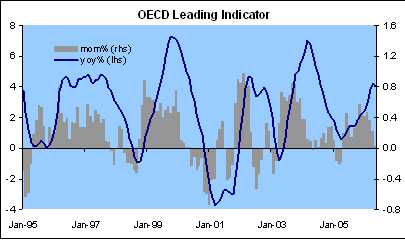
In the US the ending of the tightening cycle and the prospect of easing rates is usually a driver to significant share and bond market rallies. This was the case in the mid-1980s and mid-1990s. Could it be repeated now? It depends on whether the Fed goes one rate rise too many and trips the US into recession.
So just as in New Zealand, the US markets are currently hostage to Central Bank policy. To date the Fed has done a good job through the tightening cycle and if this continues, a case can be made for a significant rally in the US because:
Source: First NZ Capital
In the US the ending of the tightening cycle and the prospect of easing rates is usually a driver to significant share and bond market rallies. This was the case in the mid-1980s and mid-1990s. Could it be repeated now? It depends on whether the Fed goes one rate rise too many and trips the US into recession.
So just as in New Zealand, the US markets are currently hostage to Central Bank policy. To date the Fed has done a good job through the tightening cycle and if this continues, a case can be made for a significant rally in the US because:
- P/Es have contracted so far that they can expand from here, lifting sharemarket valuations as long as earnings deliver;
- global economic growth is still strong and well co-ordinated;
- excellent productivity in that country continues;
- corporate balance sheets are in good shape.
- P/Es are high relative to our history and relative to the rest of the world;
- economy is more fragile and vulnerable to a slow down;
- economy is more reliant on a buoyant housing sector to keep consumers buying.
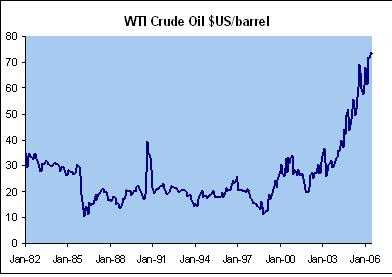 The US has also contributed with record gasoline demand there in June. This is despite retail petrol prices hitting US$3 a gallon, near the inflation adjusted high of the early 1980s of $3.18. It does illustrate the strength of the global economy that demand for oil has been so seemingly unaffected by its strong price rise.
While many other commodities suffered a sell-off in May/June oil prices stayed strong suggesting they are under pinned at current levels and demand pressures are behind this. Until now the rise in oil prices has been driven mainly by demand factors (the China effect etc) but at present the world is extremely vulnerable to a supply side shock. Most of the world’s surplus capacity is currently in Saudi Arabia with very little excess from the other main producers.
While decelerating global growth will impact on oil prices, they may only slow the rate of increase rather than cause a significant reversal. It is hard to make a bearish case for oil, other than a prolonged global recession and/or a one-off shock such as bird flu. While both are not impossibilities, for oil the risks currently seem to be on the upside from continued demand pressures, with escalating Middle East conflicts being a wild card. With Iran the 5th largest oil producer it will probably continue to play on this from time to time given its nuclear aspirations. And of course we have the US hurricane season still to come this year!
On the positive side, according to the Paris-based International Energy Agency, OPEC’s idle crude oil capacity will reach 4.2-6.1 million barrels a day in 2011, up from about 2 million a day now. Looking further out than this, oil at these prices or even higher will be a spur to more exploration as well as new technologies and innovations to find alternatives. However, that looks a long way off at present and we all probably have to get used to higher oil prices in the interim.
So unless something unexpected happens there is unlikely to be any “easy out” for Central Banks from falling oil prices. Instead they will have to earn their money and carefully balance the risks of global recession with stagflation. The role of the Central Banker is never easy with economic and market commentators constantly second guessing them and saying what they should have done with the benefit of hindsight. However, it is a particularly difficult role at present as the global economy decides which road (recession/stagflation or non-inflationary growth) to go down.
To see how the numbers stacked up for various markets around the world in the past month and over the year, visit our
The US has also contributed with record gasoline demand there in June. This is despite retail petrol prices hitting US$3 a gallon, near the inflation adjusted high of the early 1980s of $3.18. It does illustrate the strength of the global economy that demand for oil has been so seemingly unaffected by its strong price rise.
While many other commodities suffered a sell-off in May/June oil prices stayed strong suggesting they are under pinned at current levels and demand pressures are behind this. Until now the rise in oil prices has been driven mainly by demand factors (the China effect etc) but at present the world is extremely vulnerable to a supply side shock. Most of the world’s surplus capacity is currently in Saudi Arabia with very little excess from the other main producers.
While decelerating global growth will impact on oil prices, they may only slow the rate of increase rather than cause a significant reversal. It is hard to make a bearish case for oil, other than a prolonged global recession and/or a one-off shock such as bird flu. While both are not impossibilities, for oil the risks currently seem to be on the upside from continued demand pressures, with escalating Middle East conflicts being a wild card. With Iran the 5th largest oil producer it will probably continue to play on this from time to time given its nuclear aspirations. And of course we have the US hurricane season still to come this year!
On the positive side, according to the Paris-based International Energy Agency, OPEC’s idle crude oil capacity will reach 4.2-6.1 million barrels a day in 2011, up from about 2 million a day now. Looking further out than this, oil at these prices or even higher will be a spur to more exploration as well as new technologies and innovations to find alternatives. However, that looks a long way off at present and we all probably have to get used to higher oil prices in the interim.
So unless something unexpected happens there is unlikely to be any “easy out” for Central Banks from falling oil prices. Instead they will have to earn their money and carefully balance the risks of global recession with stagflation. The role of the Central Banker is never easy with economic and market commentators constantly second guessing them and saying what they should have done with the benefit of hindsight. However, it is a particularly difficult role at present as the global economy decides which road (recession/stagflation or non-inflationary growth) to go down.
To see how the numbers stacked up for various markets around the world in the past month and over the year, visit our Anthony Quirk is the managing director of Tyndall Investment Management New Zealand Limited (Tyndall).
Want to read the full article?
Click the button below to subscribe and will have free unlimited access for a limited time to full article and all other articles on the site.
You will also be able to comment on articles on Good Returns.
Latest News

4 min read


3 min read

3 min read