


Market review: So far so good – but will it continue?
|
This market summary is provided by Tyndall Investment Management New Zealand Limited (Tyndall). To see how the numbers stacked up for various markets around the world in the past month and over the year, visit our Monthly Market Review here |
The consensus scenario
As 2006 kicks into gear I find myself agreeing with the general consensus that this year:
- the New Zealand economy and sharemarket will struggle;
- the global economy will produce good growth (over 4%) with global sharemarkets following suit;
- the kiwi dollar will fall significantly at some stage;
- domestic bonds will do better than global bonds given the respective stages of the domestic and global economies.
So we have a scenario of a better balanced "goldilocks" global economy, which is neither too strong nor too weak.
Part of this pleasant outlook is Japan (2%-plus growth) and Germany starting to contribute after the US and China have had to make much of the economic running over the past few years.
The Asian outlook is particularly rosy with domestic demand now driving those economies, rather than totally relying on the US consumer.
This shift and a more balanced regional growth profile makes the world economy better able to withstand the impact of an (inevitable) slowdown in US consumer demand over the coming years and also help to address the significant US external account imbalance.
January's numbers supported this thesis with the hedged MSCI up 3.6% while the New Zealand sharemarket was down 0.6%.
Domestic bonds out performed overseas bonds and the kiwi dollar was weaker against most currencies, other than the US dollar and the Yen where it was flat.
While this is heartening it does make me somewhat nervous that the consensus is panning out so smoothly, with low volatility and with such great returns over the past three years. It makes me wonder where the surprise potential for markets lies.
The rest of this month's commentary explores three scenarios that might cause the consensus to founder.
Surprise Number One:
Too much global growth rather than too little
Alan Greenspan has now retired and looks to have handled very well the various crises that have landed on his plate.
He has managed to steer the US (and the global) economy through:
- the 1987 sharemarket crash (which was a baptism by fire!);
- the 1994 bond market crash;
- the Asian currency crisis of 1997/8;
- the Russian bond crisis of 1998;
- the tech bubble bursting in 2000; and
- the 9/11 disaster,
without inducing a major recession.
The lessons of the Great Depression occurring after the 1929 crash have been well learnt it seems.
He has generally erred on the easier rather than tighter side of monetary policy to help the US cope with the various problems it faced in his tenure.
The legacy of Greenspan, however, appears to be the potential problem of too much growth, induced by relatively easy monetary conditions over the past few years.
This has kept the US consumer spending and has resulted in an unbalanced US economy and a potential asset bubble in the US housing market.
Most would prefer to have this situation than a recession and too little growth. However, when such imbalances and bubbles unwind it can get pretty ugly!
Whether it is induced by the market or the new Fed Chairman there is the risk of higher global bond yields as a reaction to higher than expected global growth and the need for a lower US dollar.
As we saw in 1994 such bond rate adjustments can have significant short-term negative market impacts.
Surprise Potential Number Two:
The NZ economy and sharemarket surprises on the downside.
In looking at the New Zealand economy I feel it is easier to see more downside surprise potential than upside.
Very low business confidence, falling consumer confidence, softer commodity prices and a high kiwi dollar all combine to suggest that we could experience a recession this year (that is, two consecutive quarters of negative GDP).
While the domestic sharemarket appears sanguine about this I think it faces the risk of a material sell-off as the number of companies reporting profit downgrades accelerates.
While analysts have already allowed for this to an extent in their forecasts they may have under estimated this – as they tend to do in significant up and downturns.
That is, analysts are generally loath to decrease their earnings forecasts in one hit – it tends to be more death by a thousand cuts.
The New Zealand equity market is especially vulnerable to a significant correction as it remains highly priced relative to historic levels.
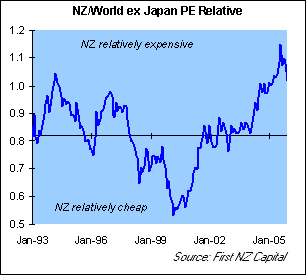
This contrasts with most major global markets which appear fairly but not overpriced.
Price/Cash Earnings
Region
Current
20 Yr Range Click the button below to subscribe and will have free unlimited access for a limited time to full article and all other articles on the site. You will also be able to comment on articles on Good Returns.