



Tyndall Monthly Commentary: Another Year of Two Halves
It is perhaps worrying that the legions of analysts that pore over the economic data largely failed to recognise these rather alarming facts during the early part of the year but we suspect that they were being implicitly swept along at that time by the feelings of euphoria that seemed to be sweeping the financial markets at that time. For our part, we believe that this feeling of optimism within the markets was caused not so much by hopes for a global economic recovery but rather by a new expansion of credit within the financial markets which looked (and indeed felt) remarkably reminiscent of the events that occurred back in the mid 2000s before the Global Financial Crisis. Certainly, we find that the investment banks were very active over the quarter, although not always with positive outcomes as JP Morgan was subsequently to reveal....
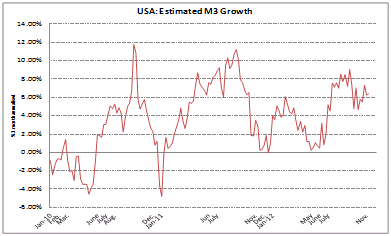
Over recent weeks, however, clear signs have emerged that the new leverage boom within financial markets has come to an abrupt end. One of the lesser known impacts of the Global Financial Crisis has been to oblige most lenders to require the depositing of suitable collateral when they extend credit to a borrower and, as more and more securities are downgraded by the rating agencies, we are finding that there is now a shortage of suitable or eligible collateral within the system. This is one of the reasons that US, German and Japanese bond prices are so high currently; these instruments are deemed as being eligible collateral and hence there is now a huge demand for these instruments that has been made even more acute by the nervousness created by the latest instalment of the Euro Crisis.
Click the button below to subscribe and will have free unlimited access for a limited time to full article and all other articles on the site.
You will also be able to comment on articles on Good Returns.



![[Weekly Wrap] KiwiSaver in play; but outcome unclear](https://goodreturns.publit.io/file/c_fill,w_300,h_200/0ad582e4-c9a3-4692-bbe2-62d928f77fd2.jpg)