




When a rising tide no longer lifts all boats
While most markets were softer, ‘growthier’ sectors came under much more pressure. The tech laden Nasdaq Composite in the US fell over 13%, dragging the broader S&P500 benchmark down nearly 10% for the month. In contrast, the broader and older economy-dominated NZX50 and ASX200 were only down 1.9% and 1% respectively.
Recent market dynamics, amidst elevated levels of inflation and the onset of a global rate tightening phase, have also raised questions around the merits of “passive” versus “active” investing strategies. This has always been the subject of much debate, with both approaches clearly having pros and cons. Passive investing strategies have arguably suited many investors well during the bull market, but equally active strategies often start to display their credentials in a scenario where “a rising tide no longer lifts all boats.”
Passive investing is a strategy which typically tracks a market-weighted index. The concept is not new, with index funds first introduced in the 1970s, but has exploded with the development of exchange-traded funds (ETFs) in the 1990s. Active strategies by contrast look to outperform the market by buying and selling shares that are seen as undervalued or overvalued respectively.
Proponents of passive investing strategies argue that funds that simply track an index have lower running costs and are cheaper. Their general claim is also that active managers are generally not able to consistently beat the market. This is a simplistic view, and one that ignores some fairly basic points.
The first is that while passive strategies have outperformed active strategies over certain periods, the opposite has also often been true. Both strategies have “ebbed and flowed” over the past 30 years as the chart below shows. The chart compares the rolling monthly 3-year performance percentile rankings for active managers with that of passive managers ranked within the Morningstar Large Blend category (23% of the entire US mutual funds market) for the S&P500.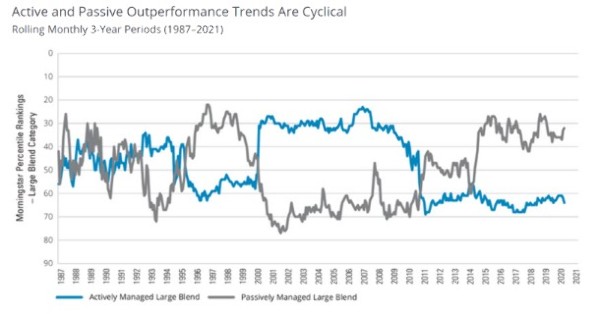
Source: Morningstar/Hartford funds
As can be seen, above active strategies outperformed for a sustained period during the mid-90’s and then also from the start of the new millennia until just after the GFC. And while the tide has turned of late, passive strategies have largely been on top since the GFC.
There has been a proliferation of ETFs since the GFC, but this has largely coincided with a bull market over the past decade (punctuated by a relatively brief pandemic-induced correction in March 2020). The ETF industry has yet to face a stern test in terms of an elongated period of volatility. Passive strategies by their nature can’t protect investors from periods of volatility, in the asset class benchmarks that they are designed to replicate. We can see this historically with active strategies substantially outperforming during the 27 market corrections in the US over the past 34 years.
Click the button below to subscribe and will have free unlimited access for a limited time to full article and all other articles on the site.
You will also be able to comment on articles on Good Returns.


![[Weekly Wrap] KiwiSaver in play; but outcome unclear](https://goodreturns.publit.io/file/c_fill,w_300,h_200/0ad582e4-c9a3-4692-bbe2-62d928f77fd2.jpg)