About Good Returns  |  Advertise  |  Contact Us  |  Terms & Conditions  |  RSS Feeds Other Sites:   depositrates.co.nz  |   landlords.co.nz
Last Article Uploaded: Thursday, February 9th, 1:24AM
rss
Investment News

It's better to be first

Stephen Wilson, chief executive officer, Equitable Group of Companies looks at the security of fixed interest investments.

Friday, May 16th 2003, 11:42AM

Open the business section of any newspaper and you will see a raft of interest-bearing investments on offer.

The proliferation of finance companies in recent years, seeking hard-earned investor savings to fund lending and leasing activities, has changed the New Zealand fixed interest market.

Investors tend to see the fixed interest market as simple, easy to understand and inherently low risk – a safe haven that generally outperforms bank deposit returns.

Most fixed interest investments are promoted as “secured”, but is the investors’ sense of security misplaced? Are investors, in reality, exposing themselves to the very equity risk they are seeking to avoid?

Lending is a risk based business and financial services companies can and do collapse – remember Securitibank, RSL, Equiticorp, and DFC to name but a few. More recently we’ve seen a number of high profile defaults in the New Zealand bond market.

So, how secure is a fixed interest investment likely to be in the case of a financial collapse?

The security of an investor’s funds will largely be determined by the recovery that the finance company achieves on its loans. This will essentially be a function of underlying borrower quality and/or the strength of the security held.

In the property market, the finance rate charged by lenders (ie: the true cost of borrowing including all interest costs, fees etc) will vary depending on the type, size and risk profile attached to a specific loan.

In most cases, as the level of risk increases so does the finance rate charged.

For example, the cost of borrowing second-mortgage secured finance is usually considerably higher than on a first-mortgage basis, reflecting an increased risk premium.
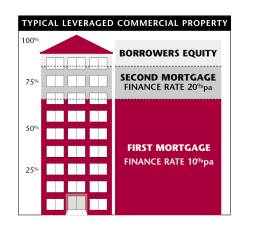
This is because, when a First Mortgagee seeks to recover their debt through the sale of a security property, several things are likely to prejudice the Second Mortgagee’s position as illustrated in the following table:

FIRST MORTGAGEE RISK

  • The First Mortgage holder is first in line for re-payment in a recovery situation
  • The level of debt recovery is dependant on the strength of the security held
  • In most cases 100% of the loan is recovered


SECOND MORTGAGEE RISK

  • Only after the First Mortgagee has been paid in full will the Second Mortgagee have access to any remaining funds.
  • Assessed asset values are usually significantly discounted in a mortgagee situation (often by 15-20% or more) prejudicing the Second Mortgagee’s position.
  • A First Mortgagee’s priority over sale will include payment of accrued interest (at penalty rates) together with recovery of costs incurred, further eroding the funds available for repayment of the Second Mortgagee.


This is not to say second-mortgage or higher risk lending is bad – far from it. As long as the lender in question is not overly exposed to high risk transactions and has a spread of relatively modest loans compared to its capital base, a small number of defaulting loans are in themselves unlikely to put the company (and therefore the investor) at risk.

History has shown us however that financial failures do occur. Investors should therefore understand that in the event of a financial collapse (as unlikely it may seem at the time of making the investment), the level of capital that will be returned is likely to be directly related to the underlying lending risks assumed by the institution in question.

When making higher risk investments, it is important that the return to the investor should adequately compensate for the increased risk being assumed. If a finance company is charging a significant interest rate for the risk that it is exposed to, an appropriate risk premium should be paid to the investor.

The majority of investors in fixed interest securities are not risk-takers. Many are at or near retirement, cannot afford the risk of capital loss, and invest in the expectation that capital return is assured.

Equitable is therefore an excellent place for conservative investors to consider placing funds. It provides attractive rates of return and the peace of mind of knowing that investments are backed by first-mortgage security.

At Equitable all mortgages and investments are held by an independent statutory trustee, Tower Trust Limited, to further protect the interests of the investor.

For a range of investment products that are tax-effective, flexible, offering excellent security and returns it is hard to go past Equitable.

An Equitable Group of Companies advertorial. Stephen Wilson is the chief executive officer, Equitable Group of Companies.

« Spicers' Quarterly Strategy PaperKing builds an empire »

Comments from our readers

No comments yet

Add your comment:
Your name:
Your email:
Not displayed to the public
Comment:
Comments to Good Returns go through an approval process. Comments which are defamatory, abusive or in some way deemed inappropriate will not be approved. It is allowable to use some form of non-de-plume for your name, however we recommend real email addresses are used. Comments from free email addresses such as Gmail, Yahoo, Hotmail, etc may not be approved.


print

Printable version  

print

Email to a friend
Subscribe to our newsletter

Deposit Rates newsletter

Latest Blogs

Goldie: FATCAT. Opps I mean FATCA
I’m sure someone with a sense of humour thought up this acronym. Now some of you may be asking what an earth is FATCA? It is the: “Foreign Account Tax Compliance Act” to be imposed by the United States of America in 2013.

Goldie: It’s not ethical for managers to keep getting fees on frozen funds
Is it ethical for fund managers to continue to get management fees on funds that have been frozen? Fund managers should not get paid management fees – or at best should have them severely discounted – for the period the funds are frozen.

Goldie: Risk is the likelihood of losing your hard earned wealth; Volatility is the wobbles
We all learned from the finance company debacles that valuing a portfolio with a capital item that remained at the same value, lulled many financial planners into a false sense of security.

Previous News

Monday, January 9th, 10:04AM
NZ Credit: A top performer in 2011

Monday, January 9th, 9:22AM
Tyndall Monthly Commentary

Monday, December 12th, 12:56PM
Harbour Commentary: Stable Government and economic recovery

Wednesday, November 2nd, 2:25PM
Harbour Commentary: Holes in the lifeboat

Tuesday, November 1st, 12:25PM
Tyndall Monthly Commentary

Monday, October 17th, 1:46PM
Harbour commentary: Waves of pessimism and optimism

Tuesday, October 4th, 1:40PM
Tyndall Monthly Commentary

Sunday, September 11th, 5:20PM
Harbour Commentary: Bond markets pricing in a lost decade

MORE NEWS»

Most Commented On
Mortgage Rates Table

Full Rates Table | Compare Rates

Lender Flt.

1yr

2yr

3yr

5yr


n/a n/a n/a n/a n/a
AMP Home Loans
6.24 5.59 5.89 6.45 7.25
AMP Home Loans $200k +
6.14 5.49 5.79 6.35 7.15
ANZ 5.74 5.70 5.79 6.45 7.25
ASB Bank
5.75 5.70 5.85 6.10 6.90
BankDirect
5.75 5.70 5.85 6.10 6.90
BNZ - Classic
n/a 5.75 n/a n/a n/a
BNZ - GlobalPlus
5.99 5.85 5.89 6.45 7.25
BNZ - Mortgage One
6.40 n/a n/a n/a n/a
BNZ - Rapid Repay
5.99 n/a n/a n/a n/a
BNZ - TotalMoney
5.74 n/a n/a n/a n/a
BNZ- Std, FlyBuys
5.99 5.85 5.89 6.45 7.25
CBS Canterbury
5.95 6.25 6.50 7.10 7.80
Credit Union Auckland
6.20 n/a n/a n/a n/a
Credit Union Baywide
5.85 6.15 6.65 6.95 n/a
Credit Union North
5.80 5.80 5.95 6.50 n/a
Credit Union South
5.75 n/a n/a n/a n/a
eMortgage 6.04 6.15 6.69 7.19 7.90
Fidelity Life
6.00 6.35 6.90 n/a n/a
Finance Direct
6.10 6.45 6.69 7.10 7.70
First Credit Union
6.45 n/a n/a n/a n/a
General Finance
5.95 6.25 6.50 7.10 7.90
HBS Bank
5.65 5.70 5.89 6.45 7.25
Heretaunga Building Society
5.75 5.80 6.00 n/a n/a
Housing NZ Corp
5.75 5.65 5.89 6.30 7.10
HSBC Premier 5.99 5.65 5.87 6.40 7.20
Kiwibank 5.65 5.65 5.79 6.10 n/a
Kiwibank - Capped
5.65 6.25 n/a n/a n/a
Kiwibank - Offset
5.50 n/a n/a n/a n/a
Liberty
5.75 n/a n/a n/a n/a
Manchester Unity
6.15 5.85 5.95 6.05 n/a
Napier Building Society
5.80 6.00 6.70 n/a n/a
National Bank
5.74 5.70 5.79 6.45 7.25
Nelson Building Society
6.45 6.25 6.50 n/a n/a
NZ Home Loans
5.85 5.70 5.85 6.10 6.90
NZF (LVR >80%) 6.10 6.15 7.15 7.60 n/a
NZF Standard 70
5.85 5.95 6.30 7.20 n/a
NZF Standard 80
5.85 5.95 6.90 7.35 n/a
Perpetual Trust
7.70 n/a n/a n/a n/a
Public Trust
5.60 5.45 5.60 6.15 6.95
SBS Bank
5.65 5.70 5.89 6.45 7.25
SBS Bank Special
n/a n/a 5.65 n/a n/a
Silver Fern
5.95 6.10 6.55 7.05 7.80
Southern Cross 5.95 6.25 6.50 7.10 n/a
Sovereign 5.85 5.70 5.85 6.10 6.90
The Co-operative Bank
5.70 5.70 5.85 6.15 n/a
TSB Bank
5.79 5.70 5.78 6.25 7.25
TSB Bank Special
n/a n/a 5.95 n/a n/a
Wairarapa Building Society
6.20 6.70 6.95 n/a n/a
Westpac 6.24 5.59 5.79 6.45 7.25
Westpac - Capped rates n/a 6.75 n/a n/a n/a
Westpac - Choices Everyday 5.60 n/a n/a n/a n/a
News Quiz

A restructuring process has seen the chief executive of which adviser group depart?

TNP

Newpark

Ginger Group

All quizzes »

Sponsored Links:

About Us  |  Advertise  |  Contact Us  |  Terms & Conditions  |  Privacy Policy  |  RSS Feeds  |  Letters  |  Archive  |  Toolbox
 
Site by PHP Developer and eyelovedesign.com