
FMA calls for innovation to drive financial advice uptake
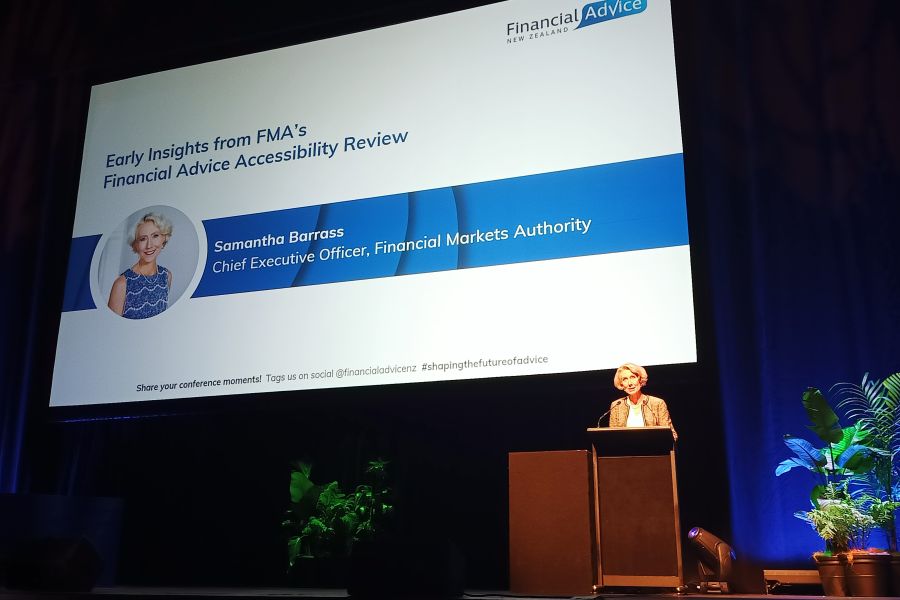
The Financial Markets Authority (FMA) is calling for Financial Advice Providers (FAPs) to innovate to encourage more consumers to use their services to improve their financial wellbeing.
Wednesday, March 25th 2026, 5:43PM
7 Comments
by Lesley Springall
Releasing the findings of its Access to Financial Advice review at the Financial Advice New Zealand (FANZ) Conference in Auckland, FMA chief executive Samantha Barrass said the review revealed a range of structural, cultural and operational barriers across the advice landscape.
One key finding was that that many providers remain uncertain about how to tailor the nature and scope of their advice, she said. “The default is to be cautious and conservative, to use the six-step advice process each and every time… making advice less accessible, not more accessible.”
Improving access to quality financial advice is not just a statutory mandate for the FMA, it is critical to New Zealanders’ long-term financial wellbeing, stressed Barrass. So if providers are limiting their advice or being overly cautious because they are worried about falling foul of the FMA’s Code of Professional Conduct that is the exact opposite of what the FMA wants, she said. “One of the messages I want you to take from today, is that we encourage you to innovate and think differently, to introduce new advice journeys that tap into consumer groups who are currently underserved.”
The FMA’s Access review, conducted from July to December 2025, included national consumer research and more than 80 interviews with licensed FAPs, financial institutions, professional bodies, technology and education providers and other organisations supporting New Zealand’s financial advice sector. Released during the FANZ conference in two separate reports (consumer and financial advice sector insights), the review highlights both the challenges consumers face and the opportunities for the financial advice sector to better meet their needs, said Barrass.
Key findings in the consumer research showed 28% of New Zealanders accessed financial advice in the past 12 months, with people from lower socio-economic backgrounds and some ethnic groups, including Māori and Pasifika, significantly under-represented. Interestingly, the survey showed that younger people (37% of 18–29-year-olds) used a financial adviser more in the last year than people aged over 60 (17%) or 50-59 (21%).
Many consumers also reported uncertainty about what financial advice is, how to access it and how much it costs, with perceptions around affordability a key barrier highlighted by both consumers and advisers. Accessibility challenges are particularly pronounced for Māori, including a lack of culturally aligned advice models and tools, said Barrass, noting this remained an untapped opportunity for the sector.
There is also a significant gap in the advice available to support New Zealanders with retirement decumulation, she said. “This is where we continue to see real opportunity for the sector. There are currently just over 100,000 people over the age of 65 in KiwiSaver. There are another 200,000 people due to be able to access their KiwiSaver in the next few years. The profession can play a key part in helping Kiwis get the advice they need to make their retirement savings last.”
Innovation is key to increasing accessibility, said Barrass. “Technology-enabled and hybrid advice models, including digital tools and AI-supported advice processes, could make advice scalable and more consistent with the right design and oversight.” However, four out of five consumers still want face-to-face conversations when thinking about financial advice, she said. “New Zealanders want both digital accessibility and human connection. Technology can automate parts of the process that currently take advisers a lot of time, freeing them up to focus more on the human conversations that consumers value.”
The advisers’ review showed there was a lot of interest and an increasing uptake in technology, including AI, said Barrass. “But they also told us they want and need appropriate support, from a training and compliance perspective.”
In the next few months, the FMA will run a series of targeted roundtables to engage with providers and the wider sector to find practical ways to improve accessibility and ensure regulation supports innovation and good consumer outcomes, she said, adding that developing new advice journeys is critical to this.
| « Longwave aims to smooth the waters | Bond funds likely to deliver out-sized returns: Amova » |
Special Offers
Comments from our readers
The businesses that could actually innovate in the advice tooling sector are not incentivised to do so on two ends.
Firstly, individual advisers are notoriously averse to paying for any SAAS offering.
Secondly, even if you do go down the route of building advice tooling - the guidelines to get a DAF license issued is about as opaque as you could possibly imagine. How do you prove a system has 'knowledge, competency and skill' equivalent to a Level-5 certified adviser? Don't ask the FMA, they haven't figured that one out and will certainly not give you any guidance.
This is where Banks could maybe move back into that space. They have the relationship.
The FMA could workshop this all day but no seasoned adviser will target these communities, not from lack of compassion, but it is not economic.
Add the fact that the amount of documents required to give simple advice now would frighten and baffle (client confusion) further putting off decision making making it even less economic.
But I do agree with @Davidvs. More platitudes of vague statements, with a sting in the tail if the FMA perceives you have crossed a line. But of course they can't tell you that until you actually do it. Makes sense, aye...
There is an work-around available to the above however that such a discrepancy exists today looks like an attempt by banks to discourage customers from using the adviser channel which I am sure if the Commerce Commission was also doing its job properly would constitute a clear breach of consumer law. That we work in an “advice orientated” industry which instead seems to be working against consumers who choose to use a mortgage adviser is absolutely appalling.
All the regulatory changes that have been introduced in the last few years essentially count for nothing if banks can be allowed to get away with the above. The FMA as a taxpayer funded government agency appears incapable or unwilling to enforce a law change introduced by Parliament to protect consumers i.e. CoFI Law. The above sums up the current state of the Wellington public service which the Public Service Commissioner himself has previously said is no longer fit for purpose saying it needs to be overhauled.
Everything the FMA has done and imposed on us has made it more expensive to be here, yet they want to tell us that affordability is a key accessibility challenge?
And then Barrass says we should all be adopting "scalable" models involving AI and tech but then says that 80% of our market wants a face to face adviser!!
Tell ya what, Ms Barrass;
after I've obtained the necessary competence, knowledge and skill, and then continually developed my competence, knowledge and skill, and protected my clients' info and given advice that is both suitable and understood, while acting with integrity and treating the clients fairly, I might try and figure a way to innovate so that I might reach some of the people who don't already want to talk to me.
After I've paid my annual registration, and my license fees and levys, and for my continued development of my competence and knowledge and skill, along with paying ever increasing costs with ever reducing commissions, I will try to find some time to innovate so that some of the people who can't afford me or the products I advise on can get "access".
Sign In to add your comment
| Printable version | Email to a friend |


More detail needed!
No adviser wishes to 'innovate' on advice delivered, outside of technology advancements, due to the associated material business risks.